
Wedding Planning · 9 mins read
How to Plan a Wedding in 2026: A Realistic Month-by-Month Guide
Wedding planning has three phases — deciding, building, and landing the plane. A realistic timeline with real budget ranges, vendor advice, and what to skip.

Most wedding planning advice tells you what to do. Almost none of it tells you what actually matters. You end up with a 200-item checklist where "book the venue" and "pick a cake topper" appear as equally weighted tasks — which is how couples spend six weekends agonizing over napkin colors and then realize, three months out, that they never asked the photographer if she's even free that day.
Here is a more honest version. Wedding planning isn't a checklist. It's three phases, each with a different job to do.
Act One
The First Three Months (12–9 Months Out)
Almost every wedding-planning regret traces back to a decision that was made — or skipped — in the first ninety days. Not the color of the napkins. The big three: how much you're spending, how many people are coming, and what kind of day you actually want.
Get those right and the next eight months are logistics. Get them wrong and you'll spend the rest of the year working around them.
Have the budget conversation before the Pinterest board
The order matters. Once you've spent two weekends pinning peony arches and Tuscan villas, every number you set afterwards will feel like a compromise. So talk money first — ideally over dinner, not over a spreadsheet.
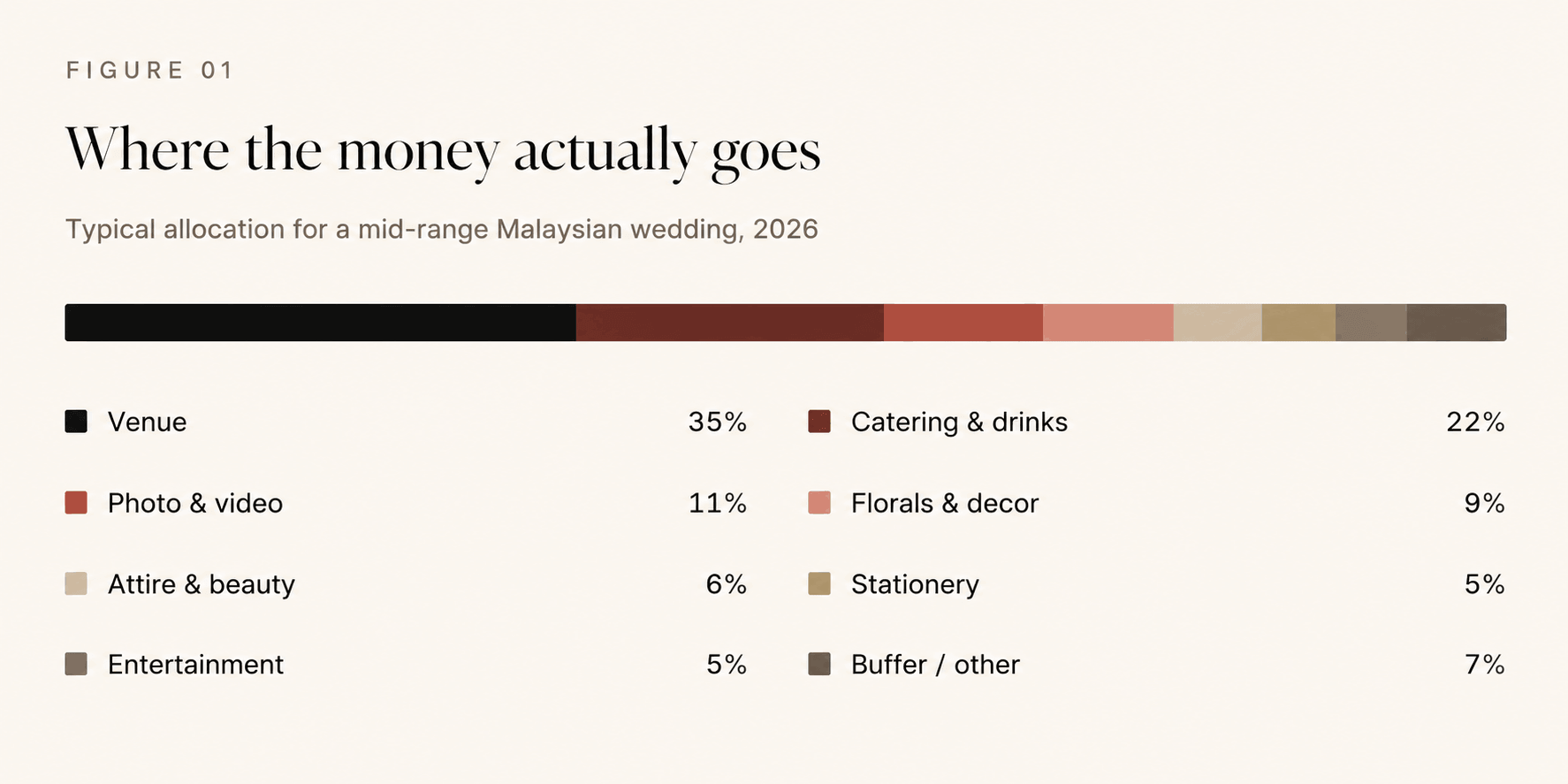
What you're trying to land on is a single ceiling figure and where it's coming from. In Malaysia, the average mid-range wedding in 2026 runs between RM 50,000 and RM 120,000 for 200–300 guests, with venue and catering eating 50–60% of that. A small wedding of 30–50 guests at a restaurant can come in under RM 25,000. Knowing which end of that spectrum you're aiming for changes every decision that follows.
If parents are contributing, find out now — not in month six.
And find out whether the contribution comes with conditions about guest count or venue type. This is one of the most common sources of late-stage planning friction.
Decide the shape of the day, not the details
You don't need a color palette. You need to know whether this is a 30-person dinner, a 300-person ballroom, a two-day affair with a tea ceremony, or a destination weekend. That single choice determines your venue shortlist, your vendor needs, and roughly 80% of your budget allocation.
A useful exercise: each of you separately writes down the three weddings you've been to that you actually enjoyed, and why. Compare notes. You'll usually find the answer is sitting in there somewhere — and it's rarely the most expensive one on the list.
Draft the guest list in pencil
Not the final list. A working number. The difference between 80 guests and 180 guests is roughly the difference between a restaurant and a hotel ballroom, and you need to know which one you're booking before you tour venues. Build two columns — definitely and maybe — and don't worry about the maybes yet.
Shortlist three to five venues
With a budget, a rough size, and a date range in hand, venue hunting becomes manageable. Visit at least two in person before falling for a third online — photographs flatter spaces in ways your guests' photos won't. Ask about guest capacity, what's included in the package, decoration restrictions, parking, and the cancellation policy. The popular venues in Klang Valley book 12–14 months out, so don't drag this stage.
Act Two
The Build (8–3 Months Out)
This is the longest phase and where most planning actually happens. The trick is to work in the right order — because some vendors book a year out and others can be sorted in a weekend, and treating them as equally urgent is how couples end up paying premium rates for whoever is left.
Book the vendors that go first
Photographers and videographers are the bottleneck. Good ones in 2026 are booking 10–14 months in advance, especially for Saturday weddings between March and June. If you have a photographer you love, book them before anyone else on this list. The same applies to in-demand wedding planners.
Everyone else — florist, makeup artist, emcee, entertainment, bridal boutique — has more flexibility. Expect to book most of them between 6 and 4 months out. Budget roughly 8–12% for photography and video combined, 8–10% for florals and decor, and 4–6% for makeup and bridal styling.
Build your wedding website before you send invitations
A wedding website is the single most useful planning artefact you'll create. It replaces about 80% of the questions guests would otherwise text you ("what's the dress code again?", "is parking available?", "what hotel did you recommend?") and gives you one link to put on every invitation, save-the-date, and reminder message.
What your wedding website should include
- Your names, the date, and the venue (with a map link)
- A schedule for the day — and the day before, if relevant
- An RSVP form that updates a guest list automatically
- Dress code, with photos if it's anything non-obvious
- Accommodation and travel guidance for out-of-town guests
- A short couple story (skip if it feels forced)
- A gallery — engagement photos or a few favorites of the two of you
Set this up before you send invitations, not after. If you're using paper invitations, print a QR code that links straight to the RSVP page — modern guests will use it, and you'll save yourself the spreadsheet of replies.

Finalize the guest list and send save-the-dates
The maybes column from Act One gets resolved here. The honest test for a maybe: would you be sad if you ran into them in a year and they mentioned not being there? If not, they don't go on the list. Couples consistently underestimate how much each guest costs — in Malaysia, the per-head cost at a hotel ballroom typically lands between RM 200 and RM 450 once you factor in food, drink, and the proportional share of the venue.
Send save-the-dates around 6 months out, or 8 months for a destination wedding. They don't have to be elaborate — a single card, an email, or a wedding-website link is enough. The job is just to lock the date in calendars.
Choose your style after your venue, not before
Theme follows venue. A garden won't carry a black-tie ballroom look, and a ballroom will swallow a rustic-bohemian palette. Pick one that complements what you've booked — minimalist modern, romantic garden, classic ballroom, soft blush, traditional cultural — and let it guide florals, stationery, and dress code. Trying to impose a strong aesthetic onto a venue that doesn't want it is expensive and rarely photographs well.
Order invitations and finalize stationery
Invitations go out around 8–10 weeks before the wedding, which means ordering them by month 4. If you're doing paper, factor in 2–3 weeks for printing and another 1–2 for addressing and posting. If you're doing digital-only, you've saved yourself roughly RM 1,500–4,000 and a lot of stress.
Act Three
Landing the Plane (2 Months to the Day)
The last phase is logistics. Almost no creative decisions remain — the work is confirming, finalizing, and writing things down so that other people can run the day without asking you questions.
Two months out: confirm everything in writing
Every vendor gets a confirmation email or message that includes: the agreed package, the final payment schedule, the setup time, the delivery address, and the day-of contact person. Don't rely on a conversation you had four months ago. People forget, staff change, and "I thought we agreed on…" is the most expensive sentence in wedding planning.
One month out: build the master timeline
The single most useful document you'll create is a one-page run sheet that lists every moment of the day from morning hair-and-makeup to the last bus home. It should include: timing, location, who's responsible, and contact numbers. Share it with every vendor, the wedding party, both sets of parents, and any friend who's helping. When something goes sideways on the day — and something will — this document is what stops it from becoming your problem.
Wedding week: delegate, don't do
This is the week to hand things off, not pick them up. Assign a coordinator — either a paid day-of coordinator (RM 1,500–4,000 in most of the Klang Valley) or a trusted friend who is good with logistics and not in the wedding party. They get the timeline, the vendor contact list, and the authority to make small decisions without checking with you. Then: confirm final guest counts with the venue, pack everything you need into one labelled box per location, and sleep.
The day itself: your only job is to be present
If you've done Acts One through Three properly, the day runs without you. The flowers will arrive or they won't. The cake will be the right size or it won't. None of it is your problem on the day — that's what the coordinator and the timeline are for. The couples who enjoy their weddings most are the ones who genuinely stop checking their phone by the time the ceremony starts.
The week after
This is the part nobody tells you about. There's the practical work — thank-you messages, returning rented items, picking up the dress for cleaning or preservation, updating legal documents and ID — and there's the emotional comedown that follows any event you've spent a year planning. Both are normal. Both pass. Give yourselves a quiet week.
Final thoughts
The couples who look back fondly on their wedding planning aren't the ones who planned the hardest. They're the ones who decided early, built deliberately, and let the day be what it was going to be. Three phases. Twelve months. One decision at a time.
About the author
Marry Editorial
Wedding planning guides and tips for couples building their perfect day on Jom Marry.
Ready to start planning?
Build your free wedding website and track every task in one place.
You might also like
Why Weddings Feel Different in 2026
Average Wedding Guest Count in Malaysia: What Couples Should Expect
Complete Wedding Planning Checklist for New Couples
More to come
New stories on the way. Check back soon.